S'edav Va'aki Museum
Rating
Family of 4
About $38 for two adults and two kids aged 6 to 17, and about $26 if both kids are under 6.
Duration
Plan 1.5 to 2.5 hours. The museum itself suggests allowing about an hour and a half for exploration of the outdoor site alone, and the indoor galleries add another 30 to 60 minutes depending on how much your kids read. Families with toddlers who do the trail at a wandering pace and skip half the galleries can be in and out in about an hour. Note that the Interpretive Mound Trail closes at 4 p.m., and at twilight on Thursday evenings, so late arrivals can end up with galleries only.
Best Ages
Roughly 3 through 17, with the strongest fit from about 7 to 14. The heart of this place is a 2/3 mile outdoor interpretive trail past a platform mound, a ballcourt, full-size replica houses and a demonstration garden, so the question is less about attention span and more about walking legs and weather. Toddlers do fine because it is a walk outdoors with real things to look at and a stroller-manageable path, though they will not absorb the history. Kids 7 and up are the ones who connect the pieces, especially once they understand they are standing in an ancestral village occupied for over a thousand years, in the middle of a modern city, next to the airport. Tweens and teens studying Arizona or Southwest history get the most out of the indoor galleries. Children under 6 are admitted free, which makes it an easy try with a young family.
About
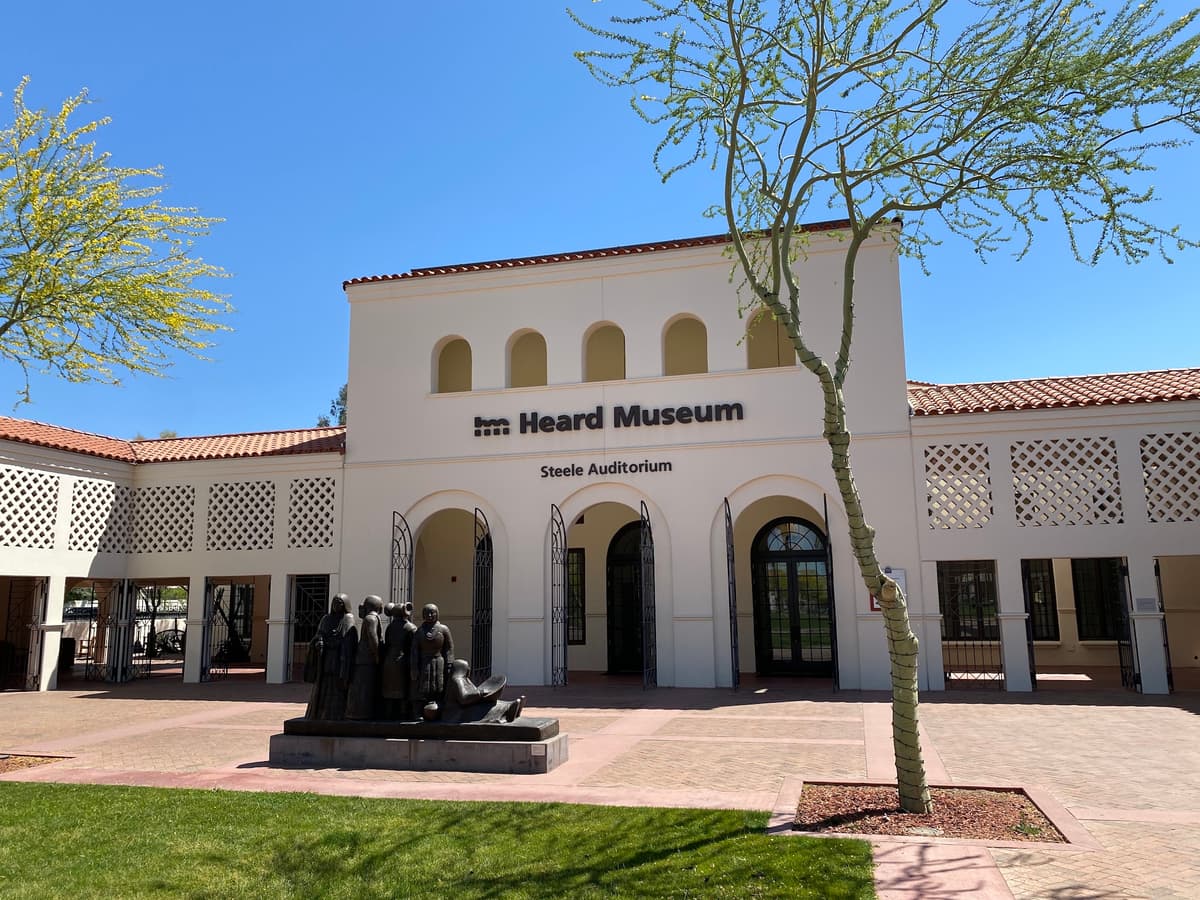
S'edav Va'aki, known for decades as Pueblo Grande, is the only publicly accessible ancestral village site inside the City of Phoenix, and that fact alone changes how kids experience it. This is not a museum about people who lived somewhere else. Your family is standing in a village settled around AD 500 and occupied for more than a thousand years by the Ancestral Sonoran Desert People, whose descendants, the Akimel O'Odham, still live in the Phoenix area today.
The centerpiece is a 2/3 mile outdoor interpretive trail. It takes you past the va'aki, the platform mound at the heart of the site, a ballcourt, full-size replicas of the houses people lived in, and a demonstration garden growing the crops that were farmed here. The centuries-old irrigation canals are still visible behind the museum.
The museum suggests allowing about an hour and a half for the site, and that is a fair estimate with kids who stop to look. The replica houses are the reliable hit: kids duck inside, size the space against their own bodies, and start asking real questions about how a family lived in one.
Indoor galleries add context and air conditioning, and they are where tweens and teens studying Arizona history get the most value. Younger kids will move through them faster than you want and then ask to go back outside, which is fine, because outside is the point.
Practical realities matter here more than at an indoor museum. The trail is exposed desert. From May through September, the 9 a.m. hour is your window, and in July and August the museum only opens 9 a.m. to 2 p.m. on Monday, Thursday, Friday and Saturday.
Regular hours from September through June are Monday, Friday and Saturday 9 a.m. to 4 p.m., Thursday 9 a.m. to 8 p.m., and Sunday 12 p.m. to 4 p.m. Tuesday and Wednesday are closed year round. The Interpretive Mound Trail itself closes at 4 p.m., or at twilight on Thursdays.
That Thursday evening window is the parent hack. Late hours until 8 p.m., discounted admission from 4 p.m. to 8 p.m., and a trail open until dark gives you cool air, low light on the mound, and a smaller crowd.
Admission is modest: adults 18 to 64 are $13, seniors $10, students with ID $6, children 6 to 17 $6, and children under 6 free. A family of four with school-age kids lands around $38. Parking is free, the site is ADA accessible with wheelchairs available, there is free indoor Wi-Fi, a museum store, and picnic areas, and it is reachable by light rail and the Sky Train.
Bring water, hats and a packed lunch, and confirm current hours at phoenix.gov before you go.
Age Suitability
Parent Logistics
Stroller-Friendly
Yes
Nursing / Changing
Unknown
Kid Meals
N/A
Setting
Indoor & Outdoor
Rainy Day
Great option!
Plan Your Visit
Best Time to Visit
Right at 9 a.m. opening, and ideally between October and April. Regular hours from September through June are Monday, Friday and Saturday 9 a.m. to 4 p.m., Thursday 9 a.m. to 8 p.m., and Sunday 12 p.m. to 4 p.m., with Tuesday and Wednesday closed. In July and August the museum runs summer hours of 9 a.m. to 2 p.m. on Monday, Thursday, Friday and Saturday, and closes Tuesday, Wednesday and Sunday entirely. Because most of the experience is an exposed desert trail, a summer visit really means the 9 a.m. hour and not much later. Thursday evenings are the exception worth knowing: the museum stays open until 8 p.m. with discounted admission from 4 p.m. to 8 p.m., and the trail stays open until twilight, which is the most comfortable warm-weather window you will get.
Wait Times
Essentially none. This is a walk-up city museum rather than a timed-entry attraction, so you buy tickets at the desk and go, usually within 5 minutes even on a busy Saturday. Free on-site parking means you are not circling for a spot either. The only pinch points are school field trips on weekday mornings during the school year and the museum's annual events.
Nearby Food
There is no restaurant at the museum, but there are picnic areas on site and a museum store, so the easiest plan with kids is to bring lunch and eat there. The museum sits on the southeast corner of 44th Street and Washington Street, an area shaped by Sky Harbor Airport and light industry rather than family dining, so nearby options lean toward fast food and airport-adjacent chains along Washington and 44th Street. For a real meal, drive a few minutes west into downtown Phoenix or east toward Tempe, both of which have far better family restaurant density. The light rail stop nearby also puts downtown dining within a short ride.
Why Kids Love It
Kids get to walk on top of a real ancestral village, not a reconstruction of one. The 2/3 mile trail takes them past a platform mound, an actual ballcourt, and full-size replica houses they can step into and size up against their own bodies, which is the moment most kids stop asking when they can leave. The demonstration garden shows the crops that were grown right there, and the centuries-old irrigation canals behind the museum turn an abstract history lesson into something they can trace with a finger.
Planes coming into Sky Harbor pass overhead the whole time, and that contrast, thousand-year-old village under a modern flight path, sticks with them.
Pro Tips from Parents
- Do the outdoor trail first and the indoor galleries second. The Interpretive Mound Trail closes at 4 p.m., and in any month between April and October the trail gets steadily less pleasant as the morning goes on.
- Download the trail guide from the museum page before you go. Having the stops named in advance turns the walk into a scavenger hunt for kids instead of a loop past unlabeled dirt.
- Check the day of the week first. The museum is closed Tuesday and Wednesday year round, and in July and August it also closes Sunday, with hours ending at 2 p.m. on the days it is open.
- Use the Thursday evening window from September through June. Late hours until 8 p.m., discounted admission from 4 p.m., and a trail open until twilight is the best combination on the calendar for a family.
- Pack a lunch and use the picnic areas. There is no restaurant on site and the immediate area around 44th and Washington is more industrial than walkable.
- Ask at the front desk about wheelchairs if anyone in your group tires easily. The museum lists ADA accessibility with wheelchairs available, which also helps with a kid who fades halfway around the trail.
What to Bring
- More water than you think you need, since the 2/3 mile trail is fully exposed desert with no shade to count on
- Hats and sunscreen for everyone, in every season, not just summer
- Closed-toe walking shoes rather than sandals for the outdoor trail
- A packed lunch or snacks to use the on-site picnic areas, since there is no restaurant
- A stroller with real wheels if you have a toddler, plus your own diaper-changing supplies since the museum does not publish its family facilities
Cost Info
Estimated Cost (Family of 4)
About $38 for two adults and two kids aged 6 to 17, and about $26 if both kids are under 6.
The posted rates are adults 18 to 64 at $13, seniors 65 and over at $10, students with ID at $6, children 6 to 17 at $6, and children under 6 free.
So two adults at $13 plus two school-age kids at $6 works out to $38, while two adults with preschoolers is just the $26 in adult admission.
Parking is free, which is not nothing in this part of Phoenix.
There is no restaurant on site, so your other real cost is lunch, and the picnic areas make packing your own the cheapest path.
Tips to Save
- Come on a Thursday evening, when the museum offers discounted admission from 4 p.
- m.
- to 8 p.
- m.
- and the trail stays open until twilight, which is both the cheapest and the coolest way to see the site in warm months.
- Children under 6 are free, so families with preschoolers only pay adult admission.
- Students with ID pay $6 instead of $13, which is worth checking for older teens.
- Parking is free and there are picnic areas on site, so bringing lunch turns a $38 outing into a $38 outing with no add-ons.
- The museum is reachable by light rail and the Sky Train, so a family already downtown can skip driving entirely.
- Ask at the desk about membership if you plan to return, since members are admitted free.
Hours & Contact
Contact
Have a Question?
Frequently Asked Questions
Tickets & Booking
Some links below are affiliate links. KidPaths may earn a commission at no extra cost to you.